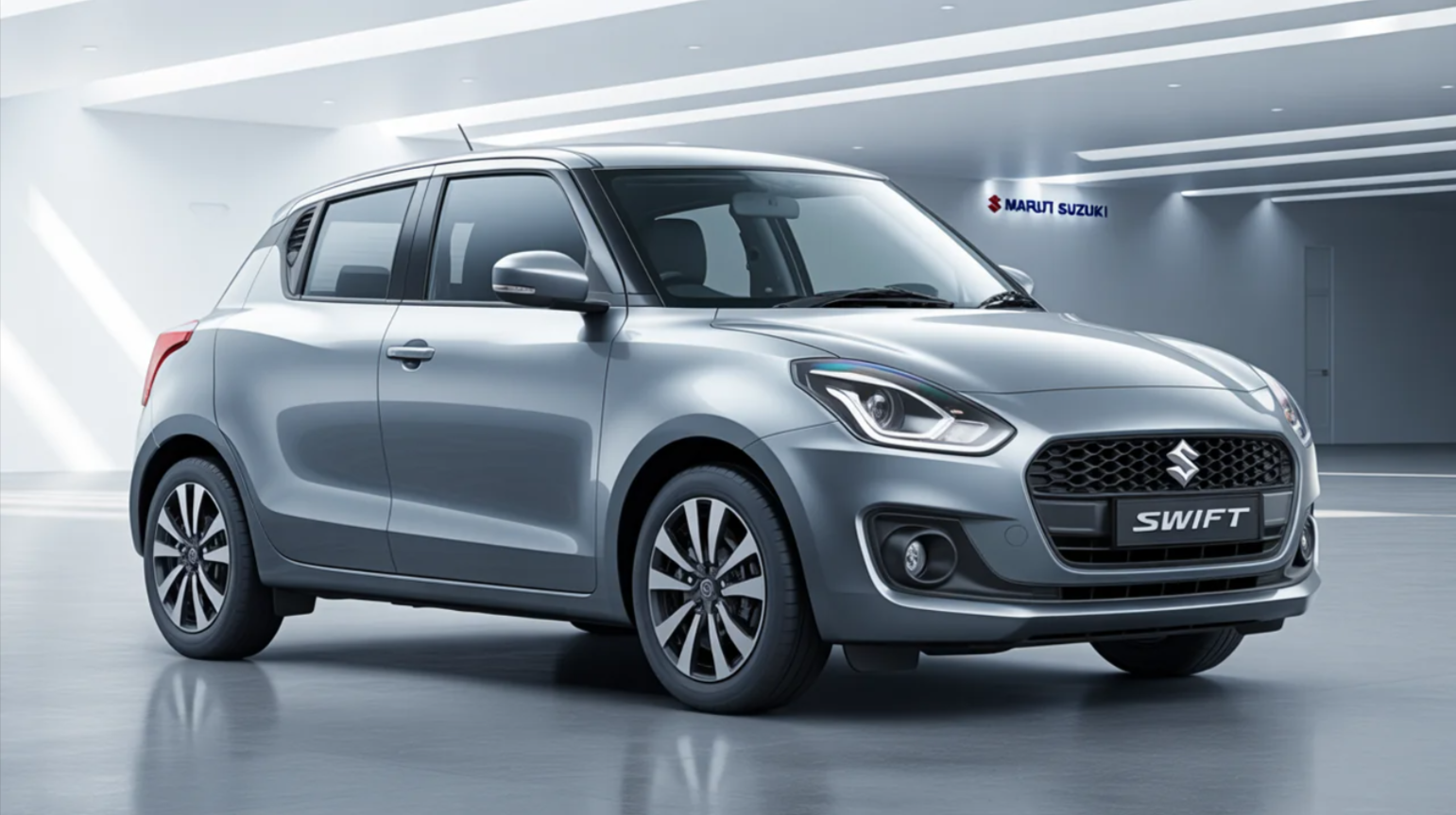

The debut of the Maruti Suzuki Swift Hybrid 2026, the country’s most recognizable small car has taken a decisive leap into electrified mobility without abandoning its mass-market appeal. At a time when fuel prices continue to nudge buyers toward efficiency-first decisions, a claimed 33 km/l figure is bound to turn heads. But is this just another incremental update, or a genuinely transformative step for India’s favorite hatch?
Design
The design of the Maruti Swift Hybrid 2026 doesn’t attempt to reinvent the wheel and that’s probably a smart move. The Swift has always been about youthful styling and compact proportions, and that DNA remains intact.
What’s new, however, is subtle but meaningful. The revised front grille appears sharper, flanked by sleeker headlamps that give the car a more assertive stance. There are minor aerodynamic tweaks too, aimed at reducing drag something that directly contributes to efficiency gains. New alloy wheel designs and discreet hybrid badging round off the visual updates.
It still looks like a Swift, but now with a slightly more grown-up, tech-forward character.
Efficiency Meets Everyday Drive ability
Under the hood lies the biggest story. The Swift Hybrid uses a 1.2-litre petrol engine paired with a mild-hybrid system an evolution of Maruti’s existing Smart Hybrid tech, but refined further for better real-world gains.
Powertrain Overview
| Specification | Details |
|---|---|
| Engine Type | 1.2L Petrol |
| Hybrid System | Mild Hybrid (ISG + Battery Assist) |
| Transmission | Manual / AMT (expected) |
| Power Output | Approx. 80–90 PS (combined estimate) |
| Torque | ~110 Nm |
| Drive Type | Front-Wheel Drive |
The integrated starter generator (ISG) assists during acceleration, reducing load on the engine. It also enables smoother start-stop functionality and recovers energy during braking. In heavy traffic conditions think bumper-to-bumper Delhi commutes this system can make a noticeable difference.
What stands out is how seamlessly the hybrid system works in the background. Unlike strong hybrids, there’s no EV-only driving mode here, but the transition between engine assistance and regeneration is nearly imperceptible.
33 km/l Mileage
Let’s address the headline number: 33 km/l. If this figure holds close to real-world conditions, it could redefine expectations in the petrol hatchback segment.
Mileage Comparison
| Model | Fuel Type | Claimed Mileage |
|---|---|---|
| Swift Hybrid 2026 | Petrol Hybrid | 33 km/l |
| Standard Swift (prev gen) | Petrol | ~22–23 km/l |
| Tata Tiago | Petrol | ~20 km/l |
| Hyundai Grand i10 Nios | Petrol | ~20–21 km/l |
Even accounting for optimistic testing conditions, a realistic 27–30 km/l in city usage would still put the Swift Hybrid far ahead of conventional petrol rivals.

For buyers, this translates directly into lower running costs especially important for daily commuters and fleet users.
Cabin Experience
Step inside, and you’ll find a cabin that builds on the Swift’s strengths while addressing past criticisms. The layout remains driver-focused, but material quality sees a noticeable upgrade.
Soft-touch inserts, improved seat fabric, and tighter fit-and-finish elevate the overall feel. The seats themselves strike a good balance between comfort and support, making them suitable for both short urban hops and longer highway drives.
Interior Highlights
- Improved dashboard textures
- Ergonomic steering and controls
- Better sound insulation
- Practical storage spaces throughout
Rear seat space remains adequate rather than generous, but that’s expected in this segment. The boot continues to be practical for everyday needs.
Tech
Maruti has wisely kept the technology suite modern without going overboard. The infotainment system is intuitive, responsive, and supports smartphone connectivity via Android Auto and Apple CarPlay.
One interesting addition is the hybrid system display, which shows real-time energy flow. While it might seem gimmicky at first, it actually encourages more efficient driving habits once you start paying attention.
Key Features
| Feature | Availability |
|---|---|
| Touchscreen Infotainment | Yes |
| Smartphone Connectivity | Yes |
| Steering-Mounted Controls | Yes |
| Hybrid Energy Display | Yes |
| Push Button Start | Expected |
| Automatic Climate Control | Expected |
This isn’t a tech-heavy car in the traditional sense but it delivers exactly what the target buyer needs.
Safety and Structural Improvements
Safety expectations have evolved rapidly in India, and the Swift Hybrid seems to reflect that shift. While exact crash ratings will only be known post-testing, Maruti has focused on improving structural rigidity and standard safety equipment.

Expected Safety Features
- Dual airbags (standard)
- ABS with EBD
- Rear parking sensors
- Electronic Stability Program (ESP)
- Hill-hold assist (AMT variants)
The lightweight platform has also been optimized for better high-speed stability something older Swifts were occasionally criticized for.
On the Road
If there’s one area where the Swift has always excelled, it’s drivability and the hybrid version continues that legacy.
The steering is light at low speeds, making tight parking maneuvers effortless. The suspension setup is tuned to absorb potholes and uneven surfaces without feeling overly soft.
What’s interesting is how the hybrid assist enhances low-speed responsiveness. In stop-start traffic, the car feels less strained, with smoother initial acceleration.
This isn’t a performance hatch by any stretch, but it remains engaging enough to keep drivers interested.
Pricing Strategy
Perhaps the most surprising aspect of the Swift Hybrid 2026 is its starting price of ₹5.79 lakh. That positions it extremely competitively, especially considering the added hybrid tech.
Expected Variant Pricing (Ex-showroom)
| Variant | Estimated Price |
|---|---|
| Base | ₹5.79 lakh |
| Mid | ₹6.5–7.2 lakh |
| Top | ₹7.8–8.5 lakh |
Maruti seems to be betting big on scale bringing hybrid technology to the masses rather than positioning it as a premium add-on.
Coupled with low maintenance costs and the brand’s extensive service network, ownership should remain hassle-free.

The Swift Hybrid isn’t just another model update it signals a shift in strategy. While full EV adoption continues to grow slowly in India, hybrids offer a practical middle ground.
For buyers who aren’t ready to go electric but want better efficiency, this car hits a sweet spot.
It also puts pressure on competitors. Brands like Hyundai and Tata may now need to accelerate their own hybrid plans in the affordable segment.
At Last
The Maruti Swift Hybrid 2026 doesn’t try to be revolutionary in every aspect and that’s precisely why it works. It builds on a trusted formula and enhances it where it matters most: efficiency, usability, and affordability.
If the claimed mileage translates even partially into real-world conditions, this could easily become one of the most sensible hatchback choices in India today.
For urban buyers, small families, and anyone tired of frequent fuel stops, the Swift Hybrid might just be the upgrade they’ve been waiting for.
