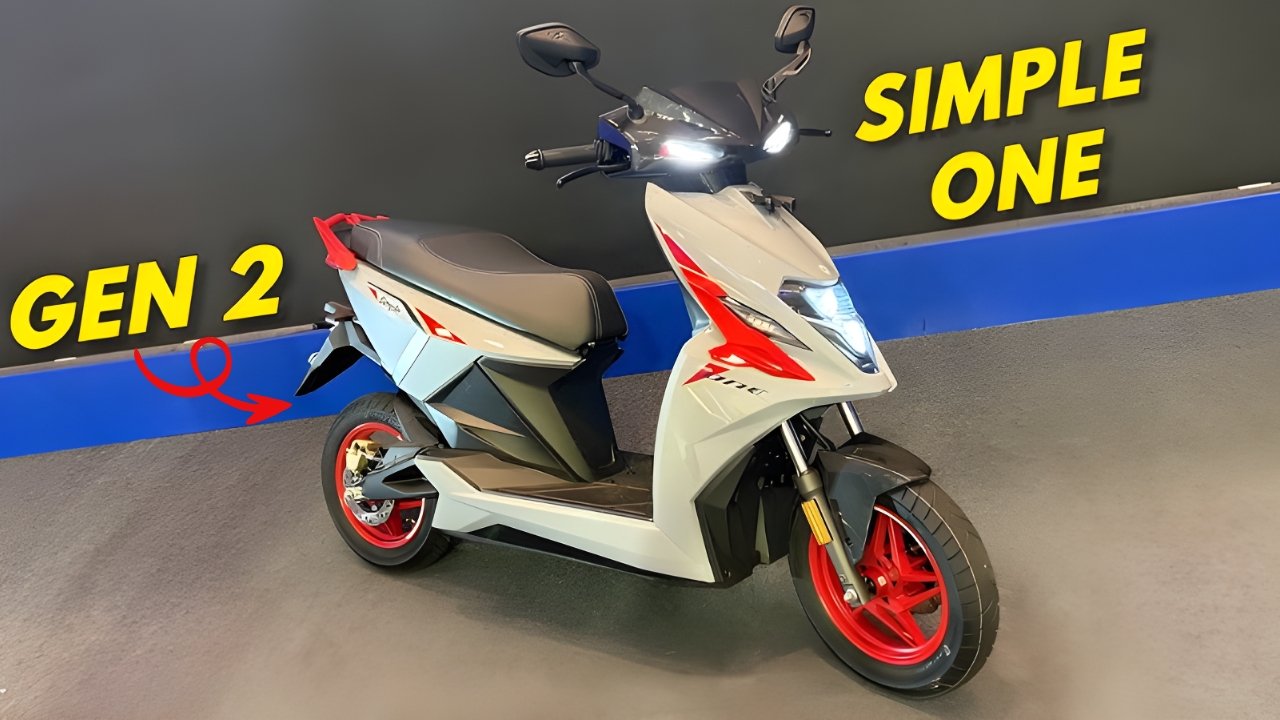

It’s getting harder to ignore what’s happening on Indian roads right now. Electric scooters once seen as niche, slightly experimental are suddenly everywhere. And not just in metro cities. Tier-2 towns, college hubs, even smaller districts… people are switching. Fuel prices are one reason, sure, but there’s also this quiet shift in mindset: cleaner, cheaper, smarter commuting. Into this crowded, fast-moving space walks the Simple One Gen 2, and it’s clearly not here to play safe.
A Range That Actually Changes Daily Commuting
Let’s start with the number that grabs attention instantly—up to 400 kilometers on a single charge. That’s not just “good for an EV,” that’s borderline disruptive in the scooter category.
For a typical office-goer in cities like Bengaluru or Pune, daily travel rarely crosses 30–40 km. Do the math, and you’re looking at charging maybe once a week… sometimes even less. That’s a big psychological shift from the “range anxiety” people still associate with EVs.
Here’s how it stacks up conceptually:
| Feature | Simple One Gen 2 |
|---|---|
| Claimed Range | Up to 400 km |
| Ideal Usage | Daily + long commutes |
| Charging Frequency | Low (weekly for many users) |
| Range Anxiety | Significantly reduced |
Of course, real-world range will vary—traffic, riding style, load—but even if you shave off a chunk, it still comfortably sits ahead of most competitors.
Performance
Some electric scooters go overboard trying to prove they’re “fast.” Instant torque, jerky acceleration, and a slightly uncomfortable ride in traffic. The Simple One Gen 2 seems to have taken a more balanced route.
The motor delivers smooth, linear acceleration. Twist the throttle, and it responds—quickly, but not violently. That matters more than people realize, especially in stop-and-go traffic where control beats raw speed.
You’re gliding through traffic rather than fighting it. No engine noise, no vibrations creeping into the handlebar. Just a quiet hum and forward motion. It’s oddly calming.
And for longer stretches—say, an early morning ride on relatively empty roads—it holds speed without feeling strained.
Design
Let’s be honest—India isn’t exactly known for predictable road conditions. You’ve got potholes, speed breakers that come out of nowhere, narrow lanes, and the occasional cow that refuses to negotiate.
The Gen 2’s design seems to acknowledge all of that.
The frame is compact enough for tight urban navigation, but it doesn’t feel flimsy. The styling leans modern—sharp lines, clean panels—but it’s not trying too hard to look futuristic. It still feels practical.

Lighting is another small but important detail. The LED setup is bright enough for night riding without being harsh, and visibility—both seeing and being seen—is clearly improved.
Tech
A lot of scooters now come loaded with features, but not all of them actually improve the riding experience. Here, the tech feels purposeful.
The fully digital display gives you the essentials—speed, battery level, ride modes—cleanly and without clutter. No unnecessary animations or distractions.
Then there’s smartphone connectivity. Pair your phone, and you get navigation, ride stats, and basic vehicle diagnostics. The companion app adds another layer—battery monitoring, location tracking, service alerts.
It’s the kind of setup that doesn’t demand attention but quietly adds convenience in the background.
Comfort
Short test rides can be misleading. The real test is how a scooter feels after 45 minutes… or an hour… especially in traffic.
The seat on the Simple One Gen 2 is wide and properly cushioned—not the kind that feels good for five minutes and then starts to punish you. Even with a pillion, it holds up.
Handlebar positioning is neutral, which means you’re not leaning too far forward or sitting too upright. It strikes that middle ground that works for most riders.
Suspension is another highlight. Indian roads can be unpredictable, and this setup absorbs a fair bit of the roughness without feeling too soft or bouncy.
Pricing
At ₹1,69,999 to ₹1,77,999, the Gen 2 clearly positions itself in the premium segment. It’s not trying to compete with entry-level EVs—and that’s intentional.
But here’s the thing: when you factor in what it offers—range, performance, features—it starts to justify that price tag.

Let’s break it down quickly:
| Factor | Impact |
|---|---|
| Purchase Price | Premium segment |
| Running Cost | Significantly lower than petrol |
| Maintenance | Minimal |
| Government Incentives | Can reduce effective cost |
Add state subsidies into the mix, and the gap between this and a high-end petrol scooter narrows more than you’d expect.
Running Costs
This is where EVs quietly win, without much noise.
Charging at home costs a fraction of what you’d spend on petrol over the same distance. Over a year, the savings add up—sometimes enough to offset a chunk of the initial purchase price.
Maintenance is another underrated advantage. No engine oil, fewer moving parts, fewer things that can go wrong. That doesn’t mean zero maintenance, but it’s definitely less frequent and less expensive.
Regenerative braking adds a bit more efficiency by feeding energy back into the battery during deceleration. It’s not magic, but every bit helps.
A Cleaner Ride, Literally
There’s also the environmental angle, which—whether people admit it or not—is becoming more relevant.
Zero tailpipe emissions mean cleaner air, especially in crowded cities where pollution levels can get uncomfortable. It’s not a complete solution, but it’s a step in the right direction.
And for many riders, there’s a certain satisfaction in knowing their daily commute isn’t adding to the problem.
Charging That Fits Real Life
Charging infrastructure used to be a major concern. It still is in some areas, but things are improving.
The Gen 2 supports both home charging and public charging setups. For most users, overnight home charging will be enough. Plug it in, forget about it, and it’s ready by morning.

Fast charging adds flexibility. If you’re in a hurry or need a quick top-up before heading out, it cuts down waiting time significantly.
Built for Both Routine and Spontaneity
What makes the Simple One Gen 2 interesting is its versatility.
On weekdays, it’s a dependable commuter—quiet, efficient, easy to ride. On weekends, it can stretch its legs a bit. That extended range opens up possibilities for longer rides without constantly worrying about charging points.
It’s not just a “city-only” machine anymore. And that’s a subtle but important shift in how electric scooters are perceived.
The Simple One Gen 2 doesn’t just check boxes—it challenges a few assumptions along the way. Range anxiety, performance doubts, concerns about practicality… it addresses them in a way that feels thought-out rather than rushed.
Is it perfect? Probably not. Real-world performance will always depend on usage conditions, and long-term reliability will reveal itself over time. But as it stands, this scooter feels like a serious contender in India’s evolving EV landscape.
And maybe that’s the bigger story here. Electric scooters aren’t just alternatives anymore—they’re becoming the default choice for a growing number of riders.
FAQs
What is the real-world range of the Simple One Gen 2?
While the claimed range is up to 400 km, real-world usage may bring it down depending on traffic, riding style, and load.
How long does it take to fully charge the scooter?
Charging time varies by method, but standard home charging typically takes several hours, while fast charging significantly reduces this time.
Is the Simple One Gen 2 suitable for long-distance rides?
Yes, its extended range makes it one of the few electric scooters capable of handling longer commutes comfortably.
What makes it different from other electric scooters?
Its standout features include exceptional range, smooth motor performance, and a strong mix of comfort and technology.
Are government subsidies available for this scooter?
Yes, depending on the state, incentives may reduce the effective purchase price.
